
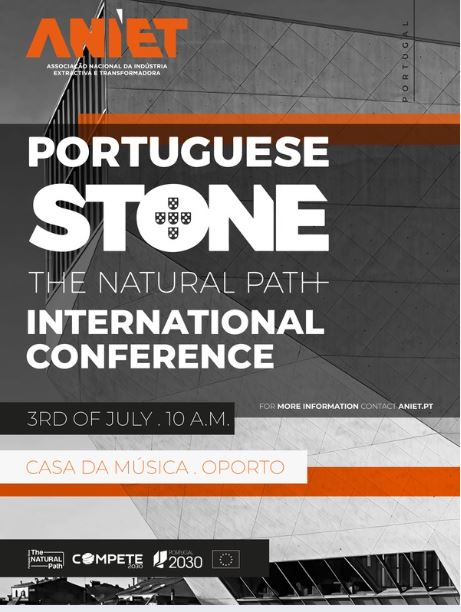
Porto, 3 July 2026 – Preparing companies for the future mandatory introduction of the Digital Product Passport in the European Union and identifying markets with strong growth potential were at the heart of the 4th ANIET International Conference, which took place this morning at Casa da Música in Porto. Organised by ANIET – the National Association of the Quarrying and Processing Industry – as part of the “Portuguese Stone – The Natural Path” project (co-funded by COMPETE 2030, Portugal 2030 and the European Union), the event brought together business leaders, researchers, consultants and international experts. With annual exports of nearly 1,200 million euros to 135 countries, the Portuguese natural stone industry now faces growing demands for traceability, certification, environmental information and technical responsiveness.
This situation was highlighted by Pedro Mêda, a researcher, consultant and lecturer at the Faculty of Engineering, University of Porto, who emphasised the impact that the Digital Product Passport (DPP) is expected to have across the entire value chain. Currently in a voluntary and development phase, the DPP will bring together information on the origin, manufacturer, technical characteristics, environmental performance, life cycle and digital documentation of each product, but is set to become mandatory under the new European regulations on construction products.
Preparations are not, however, being carried out in isolation from the industry. Pedro Mêda emphasised that the model is being developed in collaboration with business leaders themselves, drawing on the vast amount of useful data that companies already produce, albeit scattered across the different stages of extraction, processing and application. ANIET has been actively collaborating in this process, facilitating contact with companies and helping to identify, organise and structure the necessary information. For the Portuguese natural stone sector, the DPP could be a competitive advantage, by demonstrating the material’s durability, low maintenance requirements and the possibility of dismantling, cutting and reusing it, thereby reinforcing its integration into the circular economy.
In terms of internationalisation, Vince Marazita, chairman of Stone Trends International, identified the United States of America as one of the markets with the greatest potential for growth for Portuguese natural stone. The country is the world’s largest importer of processed stone products, with purchases estimated at 2.8 billion dollars. Portugal is already among the top three suppliers of made-to-measure products and, in 2025, Portuguese exports to that market reached 42.5 million dollars, up 30.8 per cent on the previous year.
The hospitality sector, high-end residential developments, airports, squares and other urban infrastructure were highlighted as particularly promising segments. Marazita argued, however, that Portuguese companies must move beyond simply selling stone to providing complete solutions, supporting projects from the selection of blocks through to processing, quality control and installation. To gain scale and access larger-scale projects, he maintained, companies must invest in domestic and international alliances, summarising this strategy with the phrase: “Partnerships are the new caravels”.
And, to navigate safely towards eastern waters, the opportunities in Arab markets were analysed by David Borges, a consultant at MAAB, who highlighted in particular the United Arab Emirates and Saudi Arabia. The construction of new cities, hotels, resorts, public facilities and luxury residential projects is generating demand for processed, certified materials with high added value, creating opportunities for Portuguese marble, limestone and granite.
Access to these markets, however, requires a sustained strategy, based on distributors with effective local networks, regular attendance at trade fairs and commercial visits, adaptation to technical standards and long-term monitoring of decision-making processes. In a context where personal relationships and trust are crucial, one-off missions or generic commercial approaches tend to yield limited results. Despite geopolitical risks, major projects continue to be backed by sovereign wealth funds and economic diversification programmes; Borges therefore argued that now is the time for Portuguese companies to position themselves.
The conference also addressed the modernisation of quarries. Luís Bento, from Fravizel, presented solutions for digitalisation, automation and electrification capable of increasing productivity, reducing consumption and recovering a greater quantity of stone from the same extraction. Among the examples highlighted were the reuse of a block that would otherwise have been destined for waste and a simulation showing that reducing losses during squaring could represent a potential annual revenue of around 871,000 euros.
The 4th ANIET International Conference formed part of the “Portuguese Stone – The Natural Path” project, co-funded by the European Union through COMPETE 2030 and targeting eight priority markets: Germany, Finland, Poland, the United Kingdom, Sweden, Saudi Arabia, the United Arab Emirates and the United States of America.
About ANIET
ANIET – the National Association of the Extractive and Processing Industries – is a Portuguese trade association, founded in 1975, which represents companies in the extractive and processing industries, with a particular focus on the natural stone sector.
Its mission is to represent and defend the sector, promote its competitiveness and support its presence in national and international markets, notably through the “Portuguese Stone – The Natural Path” project.
For further information:
Elmano Madail [BOC – Bons Ofícios Consultores]
Press Office for ANIET / Portuguese Stone – The Natural Path
Telephone: +351 911 817 827
Email: boc@boc-consultores.com
Website: www.boc-consultores.com
ANIET – National Association of the Extractive and Processing Industry
Website: www.aniet.pt
https://www.aniet.pt/pt/
