
Dr.C.H.Rao,
Secretary General, Federation of Minor Minerals Industry
Chairman, MEAI Visakhapatnam Chapter
Why make so much of fragmentary blue
In here and there a bird, or butterfly,
Or flower, or wearing-stone, or open eye,
When heaven presents in sheets the solid hue?
Since earth is earth, perhaps, not heaven (as yet)—
Though some savants make earth include the sky;
And blue so far above us comes so high,
It only gives our wish for blue a whet.
Fragmentary Blue
Robert Frost
In the global language of natural stone, blue is a rare and powerful colour. It is neither as common as black nor as predictable as grey; it carries depth, calm, elegance and drama in a single visual spectrum. From the North Coastal belt of Andhra Pradesh in India comes one of the most distinctive commercial blue granite families: Srikakulam Blue Granite, internationally known through trade names such as Bahama Blue, Orion Blue, Kingfisher Blue, Coromandel Blue, SK Blue, Andhra Blue and Robin Blue.
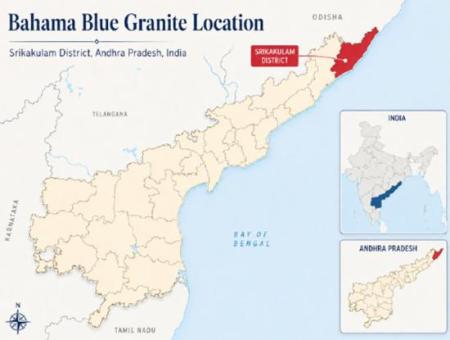
Fig.1 Location of the Blue Granite Belt
Srikakulam Blue has been exported since 1989, particularly as a monument and tombstone material mainly to European countries. Over the decades, it has earned recognition among international buyers mainly from China for its wide colour range, strong crystalline character, ability to take excellent polish, hardness, low porosity and dignified blue-grey aesthetics.
A District Built Around Blue Stone
Srikakulam District, located in the northern coastal region of Andhra Pradesh, is one of India’s important colour granite belts. The blue granite-bearing zone is mainly associated with the Tekkali and Nadigama, Saravakota and nearby regions.
According to government-recorded estimates, the reserves are about 29.25 lakh cubic metres. Today, the Srikakulam Blue granite sector represents a significant regional stone economy, with around 125 blue granite mines and more than 150 slab processing plants in the district. This cluster is not merely a mining belt; it is an integrated stone ecosystem involving quarrying, slab processing, trade logistics and export-oriented value addition. Blocks are transported to Tamil Nadu, where most of the indigenous Monument manufacturing is done.
A Geological Stone of Deep Time
The geological story of Srikakulam Blue is as impressive as its commercial story. These stones are not ordinary granites in the narrow geological sense; they are migmatitic rocks of the Precambrian Eastern Ghats Mobile Belt, formed around 1,500 million years ago in deep-crustal metamorphic environments. They are associated with partial melting, or crustal anatexis, of hypersthene gneisses and pyroxene granulites.
This geological origin, multiple metamorphic, orogenic and geo-tectonic episodes give the stone its complex mineral movement: smoky swirls, cloudy blooms, diagonal striations, fine speckles, layered flow structures and bold natural bands. Each block is therefore not only a construction or memorial material, but a visible record of deep-earth transformation.
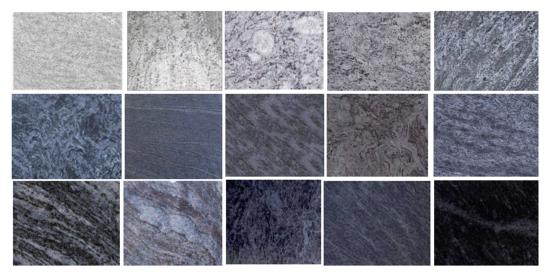
Figure 2: Various Shades of Blue Granite
The Colour Sequence: From Mist to Midnight
The most striking feature of Srikakulam Blue is its colour range. Unlike many commercial granites that are marketed under one stable colour identity, Srikakulam Blue moves across a refined sequence of blue-grey tones.
At the lighter end, the stone appears in soft silver-grey, pearl ash and misty blue shades. These varieties have a calm, European elegance, suitable for understated architectural surfaces, memorials, interior panels and refined landscape applications.
In the middle range, the colour deepens into smoky blue-grey, slate blue, steel grey and twilight blue. Here the texture becomes more expressive, often showing flowing waves, cloudy mineral patches and graceful striations. These varieties combine neutrality with personality.
At the darker end, Srikakulam Blue enters the world of indigo, graphite, charcoal and midnight blue. These stones carry a more dramatic visual weight, with stronger bands, deeper mineral flow and a luxury monumental character. The fifteen-shade visual panel in the uploaded article beautifully demonstrates this progression from pale mist-grey blues to dense, dark, almost cosmic blue-black tones.
Texture as Identity
For international buyers, colour alone is not the full story. Srikakulam Blue stands out because of its multiple textures within the same broad family. Some blocks show a finely woven mineral fabric, almost textile-like in appearance. Others reveal cloudy white blooms across a blue-grey field. Some carry diagonal movement like wind over water, while darker varieties display bold bands of charcoal, silver and indigo.
This diversity allows the stone to serve different markets. The softer shades suit contemporary design, minimal memorial architecture and refined interiors. The darker varieties suit European monuments, large-format architectural cladding, luxury flooring, countertops, memorial slabs and statement surfaces. The stone can appear calm, solemn, fluid or dramatic depending on selection and finish.
Why International Markets Value It
Srikakulam Blue’s differentiating strength lies in the combination of blue aesthetics, hardness, low porosity, uniform crystalline content and high polishability. These properties are especially important in monument applications, where durability, surface finish and visual dignity are critical.
Historically, the stone has been exported as gang-saw size blocks and cutter-size blocks, with markets including the USA, China and Europe. Production was recorded at about 0.15 million cubic metres during 2020–21, while raw block production in 2025–26 is estimated at about 0.1 million cubic metres.
For Europe in particular, the attraction lies in the stone’s restrained blue-grey personality. It is colourful without being loud, premium without being flashy, and natural without losing architectural discipline.
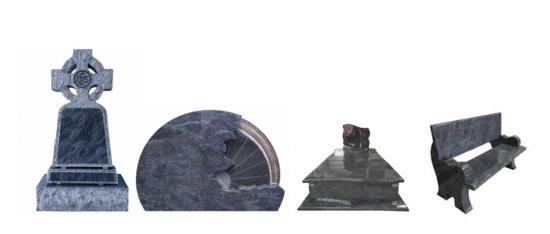
Finished Products of Blue Granite
A Stone Cluster Ready for Global Repositioning
The future of the stone lies in presenting it not as one material, but as a family of blue stones: light blue, mist blue, pearl grey-blue, slate blue, indigo blue and midnight blue.
For global architects, memorial designers, distributors and stone importers, this range offers a rare opportunity: one geological belt, many design moods.
Conclusion
Srikakulam Blue Granite is one of India’s most elegant natural stone offerings. Born in the deep crust of the Eastern Ghats, shaped by ancient metamorphism, and refined by decades of quarrying and export experience, it stands today as a distinctive blue granite family for the international market.
From mist silver to midnight indigo, from soft cloudy textures to dramatic mineral waves, Srikakulam Blue offers what few stones can: geological antiquity, commercial durability and poetic colour depth in one material.
For the global stone industry, this is not just another blue granite. It is India’s many-shaded blue from the Eastern Ghats of Uttarandra.
