Company or factory?
Published on July, 2004
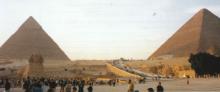
No matter how much one has heard, read, or seen in an infinite number of movies and documentaries the Pyramids of Egypt, nothing is comparable to the sensation of finding oneself in front of what is, without any doubt, the greatest architectural project in the history of Humanity. These impressive mountains of stone surrounded by a mystery even today, in the much waited twenty first century, have not been deciphered completely, they make us feel small and insignificant.
Last 19 November, the Provincial Association of Businessmen of Marble of Macael awarded the prizes of Comarca of Macael in its XX edition. In this photo-report we present the images of the works rewarded in the different categories.
AWARD TO THE ARCHITECT
Architect: José Ángel Rodrigo García
Imagess: Comercial Centre la Verónica, Antequera (Málaga)
AWARD FOR PROJECT IN SPAIN
The world of natural stone is advancing at a frenetic pace, with so many improvements in technology, that we have no time to think how we have got to this point. We thought it would be interesting to remind our readers how it used to be only a few centuries ago, take a look back and do a memory of a past age not so long ago.
This exclusive report looks at the main sources of decorative stone on the 17.075.400 km² territory of the Russian Federation, the leading quarrying and processing companies, imports, exports, the consumer market and future prospects. Author Yuri Sychov is Head of the Stone Dept. of yhe Federal Institute of Mineral Resources, and President of the Stone House Club in Moscow.
The granite water memorial to Diana, Princess of Wales, which was unveiled in London in July 2004, was produced using ground-breaking 3D technology and production techniques previously available only to the automotive industry. This technology means that for the first time, the architectural world can now create mass-produced stonework quickly, and in any combination of complex shapes and textures.

Xoan Martínez
In the last six months the world of international marine transport has suffered important tensions on a world scale that has directly affected the main sectors of our economy.
Since last December 2003, the logistical problems and, fundamentally, the increase in marine freight, has penalized exports and imports of companies dedicated to natural stone.
Floors and paving are presently the major application of stone materials being marketed constituting over 35%. In the last few decades igneous rocks, like the granite varieties and quartzitic stones have been considered, for quality and cost saving, maintenance and "durability", the most expedient materials for the purpose. The extensive colour ranges monopolized by the non-igneous rocks have now been supplemented by globalization of imports from new sources.
A Central Asian country of great natural beauty and proud nomadic traditions, Kyrgyzstan shares borders with Kazakhstan, Uzbekistan, Tajikistan and China. It is the farthest eastern Central Asian republic of the former Soviet Union. With an area of 198.500 km2 the landscape is rugged and mountainous - the average elevation is 2.750 m and almost 90% lies more than 1.500 m above sea level. Most of the 5 million or so population live in the valleys of the north and west. Agriculture (chiefly livestock farming) is the main activity.
The Inada Granite is a representative light grey natural stone of Japan for noble ornamental uses. This rock has been exploited since 1890 with stable supply up to the present. Most of Japanese traditional architectures are made up of wood, however, many modern buildings of this country adopt ornamental rocks applying to surface coating on their wall and pillar and to pavement of floor. Today, natural stones, especially granites and marbles, are dealt as noble construction materials even in the Far East of Asia.